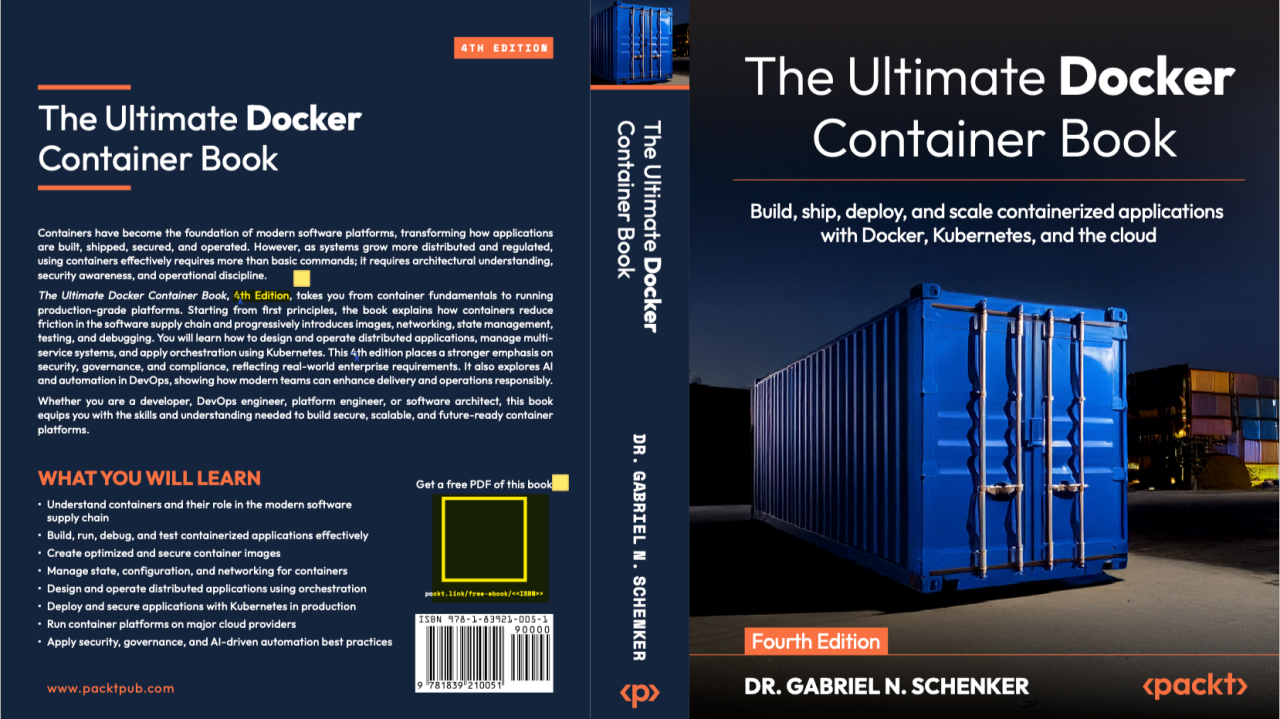
After many months of writing, reviewing, editing, and refining, the 4th edition of The Ultimate Docker Container Book is finally reaching the finish line.
Twenty chapters.
Hundreds of pages.
Dozens of hands-on examples.
As I write this, the final technical review is almost complete and the printing presses are warming up—figuratively speaking.
Writing a new edition of a technical book is a fascinating journey. Technology moves quickly, especially in the container ecosystem. Tools evolve, best practices change, and entirely new patterns emerge. Updating a book in such an environment is not simply about correcting a few commands or refreshing screenshots. It requires revisiting the whole learning journey.
For this edition, large parts of the book have been rewritten, expanded, and modernized. Some chapters have been heavily edited, many examples were updated, and several new sections were added to reflect how container platforms are actually used in modern software engineering.
The goal of this book has always been simple:
help engineers truly understand containers — not just run a few commands.
What Readers Can Expect
The book takes the reader on a structured journey from the fundamentals of containers to running highly distributed systems in production.
It begins with the basics:
- understanding what containers are and why they matter
- setting up a productive development environment
- learning how to build, run, inspect, and debug containers
From there, the book dives deeper into container engineering:
- creating optimized container images
- managing configuration, environment variables, and persistent data
- testing applications running inside containers
- improving productivity with advanced Docker techniques
Once the foundations are solid, the focus shifts toward distributed applications and orchestration.
Readers learn how modern applications are composed of multiple services and how container platforms help manage that complexity. Topics include:
- container networking
- multi-service applications using Docker Compose
- centralized logging and monitoring
- distributed application design patterns
The final sections explore container orchestration and production environments, covering platforms such as Docker Swarm and Kubernetes as well as running containerized applications in the cloud.
By the end of the book, readers will be able to design, build, deploy, monitor, and troubleshoot distributed containerized systems with confidence.
A Book Built Around Hands-On Learning
One thing that has always been important to me is that readers do not just read about containers — they work with them.
Throughout the book you will find many practical examples, command-line exercises, and small labs that demonstrate the concepts step by step. The goal is to help readers build intuition by actually running containers, exploring their behavior, and observing how distributed systems behave in practice.
Containers are one of the most transformative technologies in modern software engineering. But they only become truly powerful once you understand the underlying ideas: isolation, immutability, reproducibility, automation, and orchestration.
This book tries to make those ideas tangible.
A Personal Note
Writing a book always reminds me how much our industry evolves. Concepts that were experimental only a few years ago are now part of everyday engineering practice.
At the same time, the fundamentals remain surprisingly stable:
clear architecture, reproducible systems, and strong automation.
Containers simply give us better tools to implement those principles.
I hope this new edition helps engineers, architects, and developers deepen their understanding of container technology and build better systems.
The finish line is close now.
And I’m excited to finally share this new edition with the community.
Originally published on LinkedIn (2026-03-13): https://www.linkedin.com/pulse/crossing-finish-line-writing-4th-edition-ultimate-docker-schenker-epvje